April 5, 2026 — Easter morning. Trump posted on Truth Social:
Tuesday will be Power Plant Day, and Bridge Day, all wrapped up in one, in Iran. There will be nothing like it!!! Open the Fuckin' Strait, you crazy bastards, or you'll be living in Hell - JUST WATCH! Praise be to Allah. President DONALD J. TRUMP
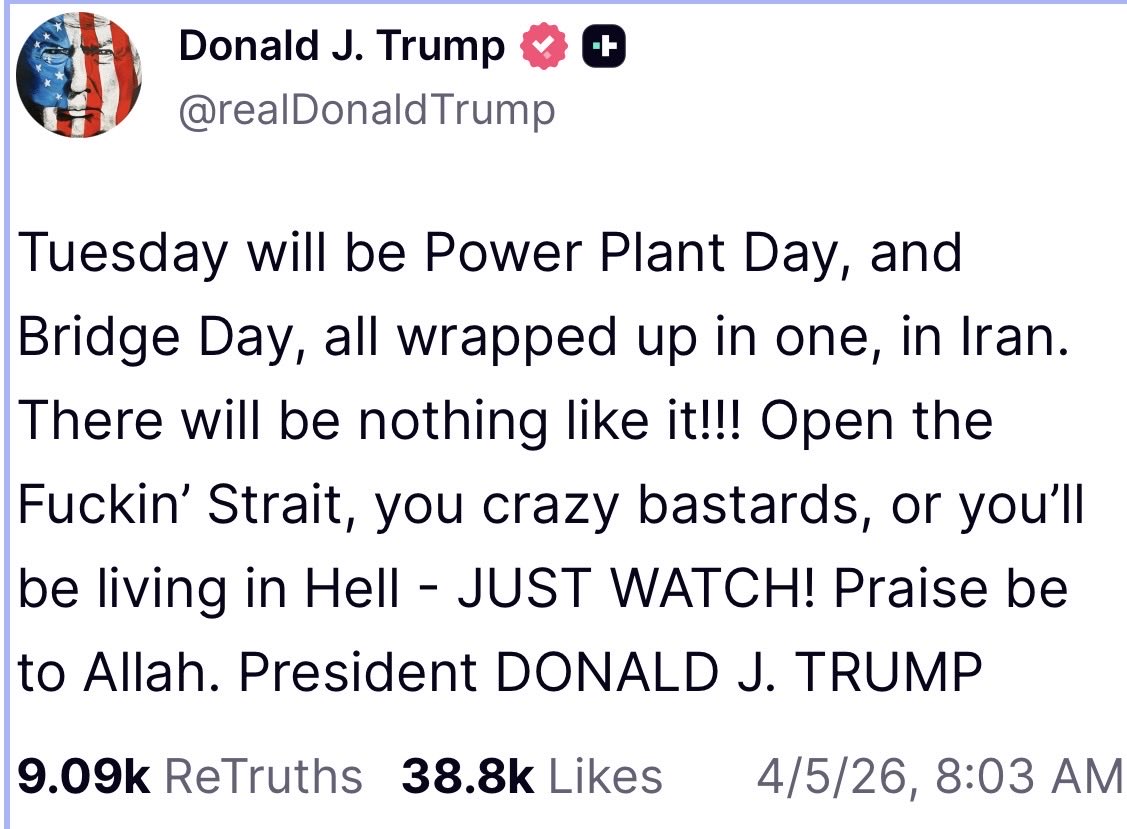
"Tuesday will be Power Plant Day, and Bridge Day, all wrapped up in one. Open the Strait, or you'll live in hell."
April 6 update: Trump extended the deadline to 8:00 PM ET, April 7 (9:00 AM Japan Time, April 8).
This is mass murder and a grave violation of international law. Will the U.S. military follow Trump's order? And this is no longer just a "Middle East war." What follows explains why it leads the world into hell.
Why Power Plant Attacks Have Never Happened Before
Middle East conflicts have lasted for decades. Yet attacks on power plants and desalination facilities were a de facto taboo.
University of Utah Middle East Center professor Michael Christopher Low notes this war "has introduced significant tensions to regional security that were previously considered taboo" (Arab News). A Project Syndicate analysis observed that "both sides' attacks have extended to all civilian infrastructure from hotels to airports, erasing virtually all existing taboos and red lines" (Project Syndicate).
The taboo existed for a reason: mutually assured destruction.
All Gulf oil-producing nations share the same vulnerability — dependence on desalination, concentrated oil infrastructure, desert environment. Kuwait depends on desalination for 90% of its drinking water, Oman 86%, Saudi Arabia 70%, UAE 42%. GCC nations operate 60% of the world's desalination capacity (Arab News).
Destroying a power plant shuts down desalination. A power attack is a water attack. Once this kind of attack is legitimized, your own infrastructure becomes a target. That is why no one did it.
The Real "Weapon of Mass Destruction" in the Middle East
Nuclear weapons function as deterrence — using one ends the user internationally. But attacks on power plants and desalination facilities can be carried out with conventional weapons and justified as "military targets." Yet in desert regions, their effect on civilian populations equals or exceeds nuclear weapons.
Iran's Parliament Speaker Ghalibaf explicitly stated: "If our power plants are targeted, we will irreversibly destroy energy and oil infrastructure across the entire region," warning of oil price increases "for a prolonged period" (Al Jazeera).
This replicates the logic of nuclear mutually assured destruction (MAD) — using water and energy instead of warheads.
Israel's Structural Contradiction
This taboo destruction is structurally suicidal for Israel too.
Prime Minister Netanyahu announced the destruction of 70% of Iran's steel production capacity and declared "bridges next, then power plants" (euronews). But Iran has already targeted Israeli power plants. Ballistic missiles struck near Hadera, believed to target Israel's largest power plant, Orot Rabin. Iranian state media published target lists including Orot Rabin and Rutenberg (Israel's second-largest plant) (Times of Israel).
The fatal asymmetry: Iran has 1.65 million km² and 90 million people. Israel has 22,000 km² and 10 million. Israel's power, water, and refining infrastructure is extremely concentrated — a handful of direct hits could paralyze the nation. Iranian missiles have already breached Israeli air defenses at Dimona and Arad (NPR). The Iron Dome is not infallible.
The side that legitimizes civilian infrastructure attacks is the most vulnerable.
Once the taboo breaks, every party can attack the other's infrastructure with the same justification. In the desert Middle East, this is equivalent to nuclear war.
And now Trump has declared "Power Plant Day." This taboo is about to be completely destroyed.
The Chain of Retaliation Begins
If Trump attacks Iran's power plants, Iran will retaliate with "equivalent" strikes against Gulf nations' power plants and desalination facilities. Bahrain's desalination plant was already damaged by drone (March 8). Kuwait's power and desalination plant was hit by missile, killing one worker (March 30). On April 3, Kuwait's desalination plant was struck again. These are still "warnings." A power plant attack pulls the trigger on full-scale retaliation.
Trump destroys Iran's power plants → Iran destroys Gulf power plants and desalination facilities
This is a chain of retaliation. Gulf nations depend on power generation for desalination. When power stops, water stops.
Simultaneously, Iran will mine the entire Persian Gulf. On March 30, Iran warned that "any attack on Iranian coastal territory would trigger mine-laying across all Gulf sea lanes." Iran retains 80–90% of its small vessels and mine-laying capability. It can deploy hundreds of mines in a short period.
62 Million People Lose Their Water
The fatal weakness of Gulf nations: they depend on desalination for drinking water.
Saudi Arabia, UAE, Kuwait, Qatar, Bahrain, Oman — six Gulf states, 62 million people depending on desalinated water. When power plants and desalination facilities are destroyed, these 62 million people lose their drinking water.
Attacking power plants is not about electricity. It's about drinking water for 62 million people.
Without drinking water, people die in days. In desert heat without air conditioning, dehydration comes even faster. The 62 million residents have only one option: flee.
A large share of them are foreign workers. Roughly 88% of the UAE's population and 85% of Qatar's are foreign nationals. They have families back home. There is no reason to stay. They will leave first. And when they leave, there is no one left to operate the remaining infrastructure.
Where do they go? Overland through Saudi Arabia to Jordan or Iraq. By sea to the Indian subcontinent. But airports and ports may not function. Dubai, Doha, and Abu Dhabi — the aviation mega-hubs — have already seen air capacity drop 26% with over 3,400 flights cancelled. Even the means of escape are limited.
The 2015 Syrian refugee crisis involved roughly 5.6 million people. The Gulf's population is 62 million.
If desalination destruction occurs at scale, the humanitarian crisis would be more than 10 times the Syrian refugee crisis. And the countries that would receive these refugees — India, Pakistan, Jordan, Egypt — are themselves in the grip of the energy and food crisis caused by the Hormuz blockade. Crisis amplifies crisis.
Why Recovery Takes a Decade
Even if the war ends, recovery does not start immediately. There is a strict sequence.
Stage 1: Mine clearance. Ship by ship, nautical mile by nautical mile. During wartime, minesweepers themselves are targets. Clearing mines across the entire Persian Gulf takes years. Until the mines are gone, no supply ships can enter.
Stage 2: Power plant and desalination construction. Only after mines are cleared can materials be shipped in. Power and desalination must be built before people can live there. Without people, nothing proceeds.
Stage 3: Refinery restoration. Only after people can inhabit the region can refinery reconstruction begin. Destroyed refineries take 3–5 years to rebuild.
Mine clearance → Power plant and desalination construction → Refinery restoration.
This sequence cannot be skipped. Each stage takes years. Full recovery takes a decade or more.
During That Decade, Oil Fields Die
While recovery stalls, oil fields continue to deteriorate. Oil fields do not recover naturally. Without continuous management, production capacity itself is permanently lost.
- Wellbore collapse — Casing corrodes from hydrogen sulfide and high temperatures. Without maintenance, wellbores collapse and must be re-drilled
- Water and gas encroachment — Without pressure control, water and gas invade the oil-bearing formation. Once invaded, original productivity never returns
- Surface equipment degradation — Pipelines, pumps, and separators corrode rapidly in desert conditions. No power means no corrosion protection
- Secondary recovery shutdown — Mature Gulf fields use waterflooding and gas injection to maintain output. When these stop, reservoir pressure drops irreversibly
Even if facilities are repaired, the oil fields may never produce the same volume again.
If recovery takes a decade, the production capacity lost during that period may never return. The world's oil supply structure changes irreversibly.
The World's Food Disappears
The Strait of Hormuz carries 20–25% of the world's seaborne oil. When oil stops, it's not that gasoline gets expensive. Food disappears.
Nitrogen fertilizer → Supports roughly 50% of global food production
The Arabian Gulf supplies 46% of global urea trade — the most widely used nitrogen fertilizer. India (18% import dependency), Brazil (10%), and other major agricultural nations are directly hit.
Gulf countries also account for roughly 45–50% of global sulfur supply — a byproduct of oil refining. Phosphate fertilizer cannot be made without sulfuric acid.
Nitrogen fertilizer and phosphate fertilizer face crisis simultaneously. The "Peak Sulfur" warned about in Chapter 11 has been made real not by decarbonization, but by war.
Without fertilizer, crops don't grow. Without crops, people don't eat.
This is not an oil problem. This is a problem for this year's food. The impact on harvests months from now has already begun.
Who Does "All Hell" Rain Down On?
Trump said "all Hell will reign down on them."
But if power plants are attacked, hell rains down not just on Iran.
- 62 million Gulf residents lose drinking water — a refugee crisis 10 times larger than Syria
- The world's fertilizer feedstocks disappear — food production for billions affected
- The world's oil supply structure changes irreversibly
- The receiving countries are themselves in the grip of energy and food crisis
"All hell rains down" not on Iran. On the world.
By the morning of April 7 (Japan Time), we need to understand this.
Will the U.S. Military Follow the Order?
Back to the opening question. Will the U.S. military follow Trump's order?
U.S. military officers have a duty to refuse clearly illegal orders. The Uniform Code of Military Justice (UCMJ) does not grant immunity for obeying unlawful commands. "I was following orders" is not a defense.
Deliberate attacks on civilian power plants and desalination facilities constitute "destruction of objects indispensable to the survival of the civilian population" — prohibited under Article 54 of the Geneva Conventions. International law experts have already called this "a threat to commit war crimes." Since Trump himself announced "Power Plant Day," the excuse of "collateral damage" does not apply. This is a declared, premeditated destruction of civilian infrastructure.
Follow the order — become complicit in war crimes. Refuse the order — trigger a constitutional crisis.
Either choice leads to an unprecedented situation for the United States.
Sources
- Arab News: Gulf water security and desalination dependency
- Project Syndicate: Iran war and the destruction of civilian infrastructure taboos
- Al Jazeera: Iran threatens regional energy infrastructure retaliation
- Al Jazeera: Bahrain desalination plant damaged in drone attack
- Al Jazeera: Kuwait power and desalination plant attacked
- euronews: Netanyahu — Iran steel production destroyed, power plants next
- Times of Israel: Iran targets Israel power plants
- NPR: Iran missiles breach Israeli defenses at Dimona and Arad